


Choosing a microcap stock to be an annual pick, or just investing in one is only half the battle. When they don’t go well early on, it’s pretty easy to cut ties, investigate where you might have gone wrong, and move along to the next one - hopefully learning something about your process along the way.
But what happens when one turns into a heater, like Kraken Robotics did? Back in late 2023, I chose Kraken as one of five Wolf Picks for 2024. It was $0.61 at the time and my average on the stock was $0.59. By March of this year, it peaked at $10.72 for a seventeen bagger. Since, it’s down 71%.
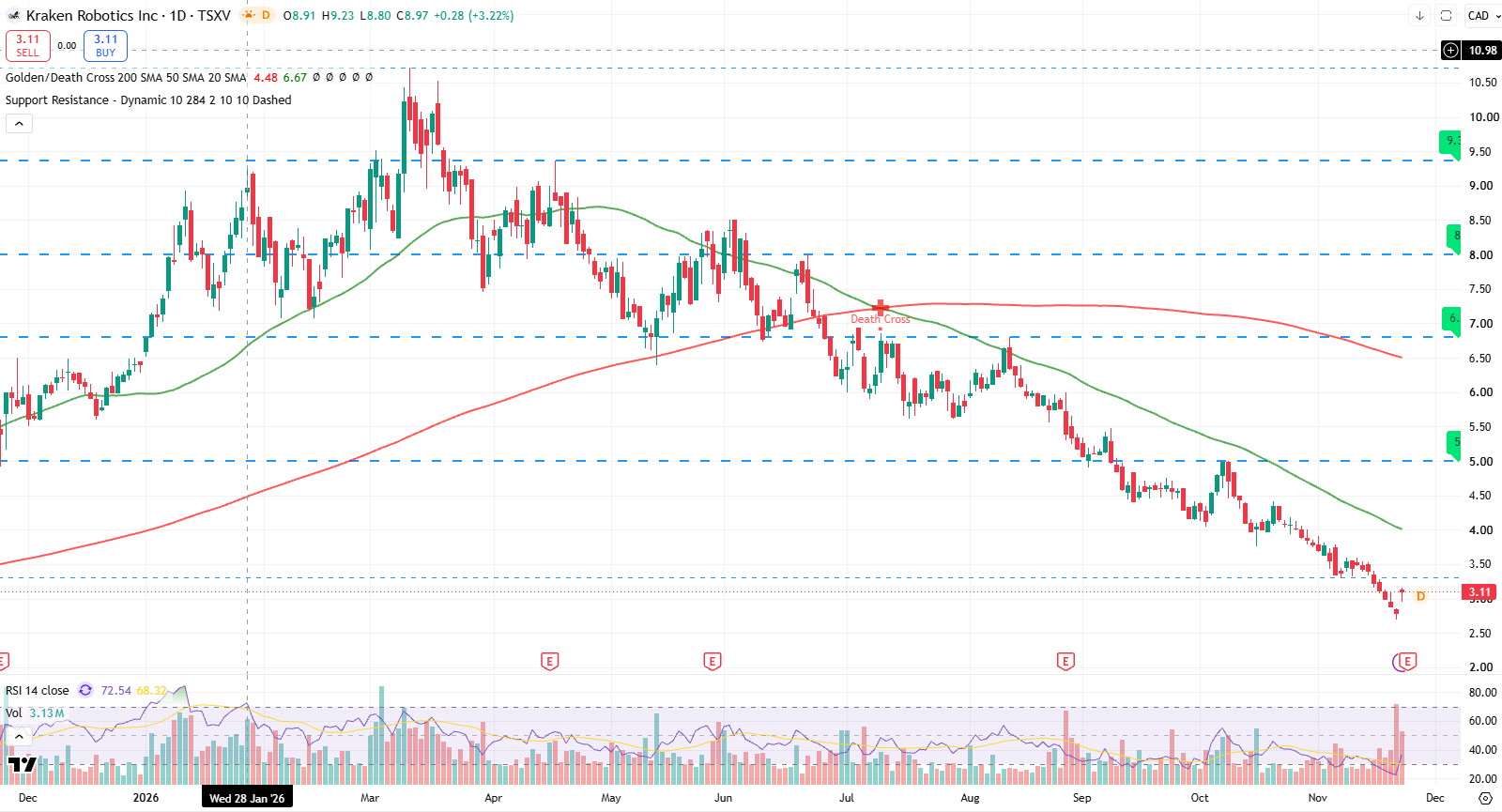
While I have been fortunate, perhaps even adept at realizing relatively early when I’ve picked a lemon (I’m looking at you here Now Vertical, NorthStar Clean Technologies and Simply Solventless), determining which of these heaters or multi-baggers is a long term keeper or a rental might be more challenging than making the pick in the first place.
To date, I have made twenty three annual or mid year Wolf Picks. More than 60% of those have gone on to double and 30% have gone to 7x or more. If “good stock pickers” have a 50% win rate, those feel like pretty solid numbers. But in order to maximize your profit potential, you must decide when to take profits, hold it, or completely cut bait.
I’d be lying if I told you I played them all well in hindsight, but Kraken is one that I feel I have done better than others.
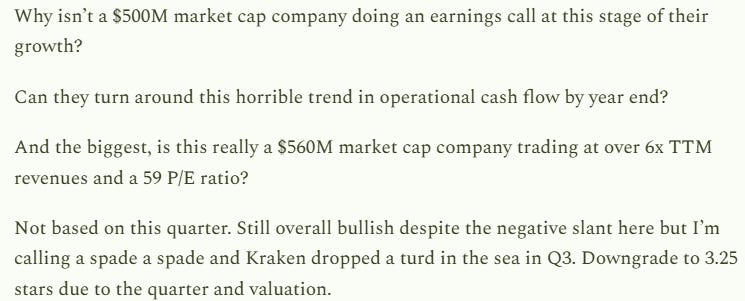
When Kraken traded over $10, it held a $3B market cap valuation. Going back as far as my Q3 review two years ago when it was just a $560M market cap, I had serious valuation questions that escalated over time.
The sector has also has/had a lot of focus, and for good reason. That can at times, bring out some questionable actors promoting and pumping the stock, and that has occurred here as well, particularly with the US OTC ticker - KRKNF as I referenced in previous reviews. It’s great long term when your holding cheap shares, but can be detrimental in the long run, as it usually results in a significant pullback. That type of pullback creates bagholders, and that’s the case here. Take a look at the Youtubers and Twitter users talking about KRKNF a year ago compared to today. Enough said.
For those reasons, I was taking profits and scaling out of the stock for sometime with my latest sell when the stock hit $9 early this year. I hold about 20-25% of my initial position 59 cents so overall Kraken has treated the portfolio very well.
That’s how we got here, but what about now? After Kraken’s blockbuster acquisition of Covelya, initially announced in March and closing in July, it has been a long wait for this set of financials from the company - the first combined look of the new entity. While Q3 financials in microcaps always feel like they have more importance due to the delay in annual filings (five months or more), this one felt like the most important set of FINS in the company’s history. This is how I positioned it in my earnings preview, What’s Wolf Watching article published a few weeks ago.
Due to the large pullback in the stock, and the bumped up guidance the company recently provided, I called it a potential risky Buy Zone opportunity. I added a few shares of Kraken for the first time in a couple of years.
Then the news release hit early this morning. Uh oh.

While the headline numbers overall looked decent, the revised guidance stuck out like a sore thumb. A sore thumb after an unwanted anal probe to be more blunt.

If there is one thing investors hate to see more than an earnings miss, it’s revised guidance to the downside. Initially, there are two concerns that come to mind. First is the amount of the revision, revenue downward on the low end by 16%, and AEBITDA by 18%. If that isn’t enough, this initial guidance came out at the end of August - when they were already two thirds of the way through Q3. It feels like a pretty wide discrepancy that late in the game when they had the opportunity to sandbag this guidance given the substantive changes to the company with the acquisition.
Let’s get into the details.
(post completion - you can probably just skip ahead to the Summary at the end)
The Company:
Kraken is a marine technology company that provides the enabling technologies behind marine platforms & systems (at surface, in the water column, on the seabed, sub-seabed). They serve both military and commercial sectors to various platforms including crewed vessels (ships and submarines), uncrewed systems (AUVs, USVs and ROVs) and stationary sensors on the seafloor.
I’ve attached their most recent investor deck below.

Balance Sheet:
Kraken still sports a solid overall balance sheet with a 3.3 current ratio. It consists of $160.5M in cash, $75.2M in receivables, $132M worth of inventory and $45.4M in other short term assets overtop of $125.7M in short term liabilities.
The company does not provide A/R aging reports. It is up 175% from the beginning of the year. Given the size of the acquisition, this doesn’t appear to be unreasonable. They anticipate writing off $784k and that is on top of $2.05M a year ago so given that, I certainly would like to see an aging report. 21% of their A/R is from two customers so it doesn’t appear to be very concentrated limiting potential risk.
Inventory levels have jumped by 3.8x since the beginning of the year, but nearly $70M came with the acquisition of Covelya.
Kraken has $149M worth of debt, much of that new stemming from the acquisition which was financed through debt, shares, and a capital raise.
Cash Flow:
A lot of activity through their first nine months of the year, but we start with $27.6M worth of cash burn, compared to burning $8.1M at the same time last year.

The working capital adjustments are more complex this time around due to the acquisition. The overall number includes the acquisition and the impact of the combined businesses since July 2nd.
You’ll note the large amounts of $47,872 and $97,772 for A/R and inventory respectively. Those include the combined businesses. The $67,364 number is the one time adjustment due to the acquisition on their working capital adjustments. Think of this as a balance sheet reset, therefore the ($25,912) would be an apples to apples comparison to last year. Also, the reference to note 7 is actually a typo and should reference note 6. Like I said, complicated and a lot of moving parts.
Even knowing that there were some fairly substantial acquisition related costs in these numbers, we’re not off to a good start here. When you look at OCF prior to working capital adjustments, they went from $14.7M generated to $1.7M of burn.
Total cash utilized for the acquisition amounted to $413.5M, and Kraken has also spent $24.2M in asset purchases.
Financing section is busy also through raising over $385M, and adding over $127M of debt load.
Overall their $160M in cash is one third better than where they began the year with.
Share Capital:
371.7M shares outstanding representing 21% dilution over the past year
15.9M shares were issued to Covelya, 47.4M in the bought deal financing
12.8M options with 7.7M currently ITM
Retail owns about 70% of Kraken with 21% owned by institutions with relatively little insider ownership. The number two shareholder is actually Sonardyne Holdings Limited, the receiver of the 15.9M shares from the acquisition. One third is scheduled for lockup until July of 2027 with the remaining thirds releasing six and twelve months afterwards

Two insiders bought on the open market in July at over $6. That has to sting.


Income Statement:
The first batch of revenue from the combined businesses was $102.2M, up 226% from the non comparable quarter last year. Gross margin was 59.8%, up 40 basis points from last year with gross profit dollars improving by 229%.
Total expenses grew by a total of 470%, significantly outpacing their revenue and GP dollar performance. The big hit came within admin costs which totaled $59.2M, 6.5x from last year.
When all was said and done, net income was a loss of $19.2M, compared to a profitable quarter of $4.4M in Q3 of last year.
YTD numbers are pretty irrelevant at this stage given the acquisitions impact on the quarter, and new guidance.
Summary:
The overall numbers look dreadful below the revenue line, but is there anything in here to give bulls some optimism?
I think so, and I didn’t think that would be the case honestly. Per the company’s MD&A, $23M of one time costs in the quarter and $25M YTD were experienced for the acquisition. First, there are your typical legal costs and advisory fees for M&A transactions. Then there are restructuring costs by eliminating positions that no longer make sense, relating to some severance/integration packages. That would be a large part of the $10M in future operational synergies. Since Covelya was a UK company, that would have triggered additional stamp duties - potentially as much as $3M on the $615M deal. $25M in expenses sounded like a lot of one time costs initially, but that works out to 4% of the acquisition costs, and it’s not atypical for these to be 3-5% for a foreign one.
So, the company’s adjusted Net Income number of $9.5M appears to be pretty legitimate. Those variances would also directly adjust and improve their cash flow for the quarter as well. I’d still look for some operational creep of costs going into at least Q4 however, so something to watch in April.
While I think the company’s usage of AEBITDA in their guidance is hot garbage, the adjusted net income number can be used to project what things may look like in the future.
It’s now post close as I finish this review up, and the stock took a shit kicking today, declining by nearly 24% to finish at $2.37 on over 8.5M shares traded - the most since June of 2025.
With a new market cap of about $870M, and under normal times generating $9.5M of net income with potentially $20M of operational cash flow doesn’t feel nearly as offside as when the company traded over $10 with a $3B market cap.
Adding to the shareholder disdain today was the downward revised guidance, and like I mentioned in the introduction, it wasn’t by just a little bit with the low end of their revenue by 16% and profitability by 18%. That is a tougher pill to swallow than any perceived disappointment in these financials. That $50M downward guidance at the midpoint came just a few months after initially providing it. There were a few points of rationale provided in the call including defence program revenue being moved into 2027 and softness within the offshore wind & renewables market, the latter isn’t expected to recover until well into next year.
Their initial guidance for 2027 looks ultra-conservative, and who can blame them really after staining the sheets so bad the last time they issued some. The company does have a record backlog with a sales pipeline of over $5B.
The biggest nuggets from the call (for me) was when they provided a “benchmark” or target for free cash flow, which is significantly more useful than an AEBITDA number. They stated that target is 40%-45% of AEBITDA. They also gave a capital spending estimate of around $30M (midpoint of 25-25).
From there we can work backwards to come up with a midpoint target of operational cash flow of around $81M for 2026. That’s taking their mid point AEBITDA of $119M, taking the midpoint of their 40-45% FCF benchmark, and adding back the mid point of their capex estimate. Got it?
That’s just under 11x forward cash flows and given the sector, potential sandbagged guidance coupled with their backlog and pipe, that appears more than reasonable. Potentially, cheap?
Kraken never deserved to be a $10 stock. I’ll die on that hill, but I think you can currently make the argument it’s worth more than $2.37 with some help getting there. How much - well that’s in the eye of the beholder, and I be holding.
Three stars.
Disclaimer:
My intent is for my reviews to be a bolt on to due diligence that you have already completed. I receive dozens of review requests a week, therefore my own DD may be great or none whatsoever. Unless otherwise stated or implied, my opinions are on the financial performance of the company based on their most recent filings. I conduct these reviews to assist other retail investors whose research skills are limited when it comes to reviewing financial statements. I do not accept compensation of any kind from companies I review.
Wolf FINS Reviews are intended to be informational and are based on personal opinion. They are not intended to be financial advice, and all readers are encouraged to perform their own due diligence prior to their investment decisions, including discussions with their investment advisor.