



Almost two months have transpired since my most recent review of Baylin Tech (attached for your potential perusal below). It was less about reviewing their Q1 financials and more of a look at their splash acquisition of Kaelus AB out of Sweden. A big hello to my 56 subscribers from the land of the Tre Kroner by the way.
Baylin Technologies ($BYL.TO) Review

Baylin has been receiving some chatter within the Wolf Den discord as of late. Not by me, but requests have come in for a review so here we sit. I tend to review a lot of companies and sometimes I forget that I’ve covered them previously, as is the case with Baylin.
The latest Q1 FINS preceded that acquisition, and due to that I left the company unrated. While these financials only have one month of revenue from the combined entities, I’ll commit to giving it a rating this time around and this comes before I have delved into their numbers.
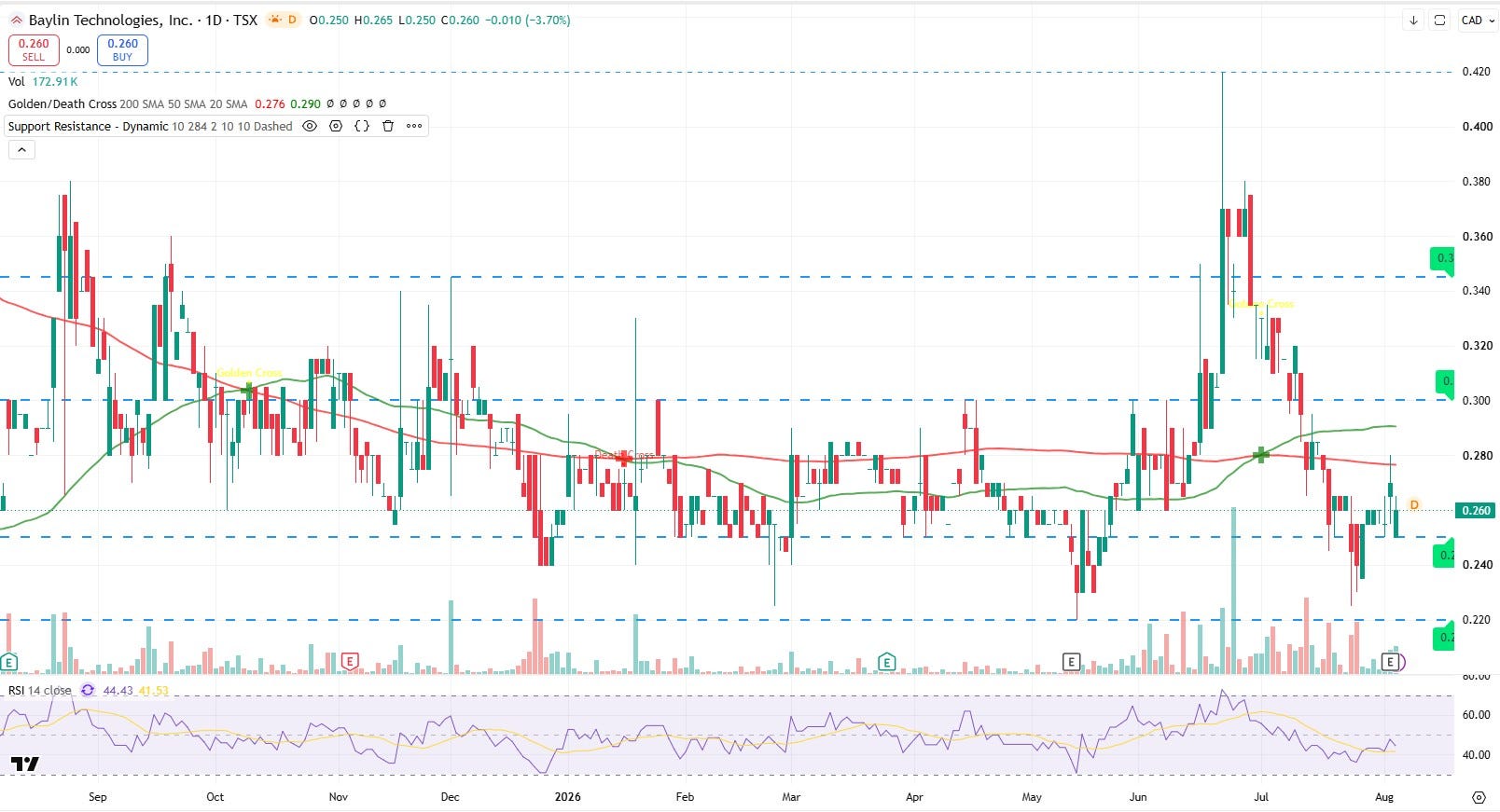
The stock is still slightly up from their Q1 financials, but down 16% from the acquisition announcement. My last review came on June 11th when the stock traded at 26.5 cents. Eleven days later the stock was up by 58%. Since then, it has given it all back, so I have some regrets for taking that starter position and holding onto it for that duration as it could have turned into a phenomenal little swing trade.
Baylin released their latest numbers after hours on Wednesday and the stock fell 3.7% yesterday (Thursday).

While the stock may be down since the acquisition, the same cannot be said for their valuation due to the significant dilution that came with buying Kaelus, going from approximately $41M to a current $73M market cap.
So let’s get into the new look Baylin Technologies and see if we can slap a rating on this bitch this time around.
(Free release on Aug 13th)
Balance Sheet:
When we last looked at Baylin, they had a dreadful looking current ratio of under 0.8. Under the combined entity that has improved to 1.1, but their liquidity still remains somewhat lacking.
They ended Q2 with $12.5M in cash, $29.8M in receivables. $28M worth of inventory and $15.1M in undefined other current assets overtop of $78.2M in liabilities due over the next twelve months. A 1.1 current ratio is what I would define as borderline acceptable. A little more than half of their current assets are made up of less liquid inventory and these “other current assets”. When you take their more liquid assets of cash and A/R, they only account for 55% of their one year commitments.
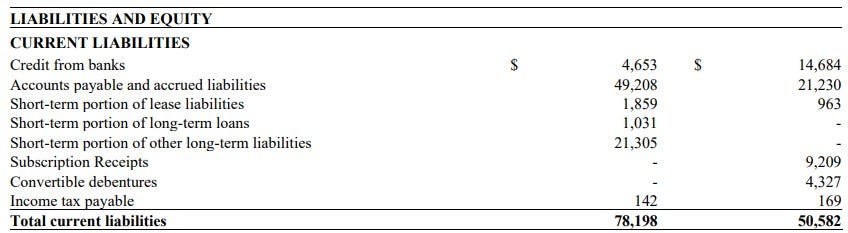
Above is a breakdown of those one year commitments and that looks rather daunting when the company is only sitting on $12.5M in cash and nearly $30M in receivables, leaving a shortfall of nearly $36M. That long winded line of “Short term portion of other long term liabilities” relates to deferred cash payments due to the owners of Kaelus AB. $14M of that is due quite soon, $11.2M by mid November and $2.8M a month later.
We don’t know exactly what is in that other current asset bucket, but it could be additional assets with more liquidity like restricted cash from Kaelus. If it is, that could improve things a great deal.
Of course, all of those above concerns can be rectified if they have strong operational cash flow (OCF) numbers. Right?
Cash Flow:
Well, so much for that as through six months BYL has burned $3.2M in OCF through six months with $3.8M burned in this most recent quarter.
They also had net cash outflows of $2.2M from the acquisition, increased their debt by approximately $4M and received $2M from the issuance of preferred shares.
Overall, they sit with approximately the same amount of cash they began the year with.
We’ll get back to this later I’m sure.
Share Capital:
281.4M shares outstanding, 84% dilution from where they began they year - all from the acquisition which made up about a third of the total purchase price
6.2M DSU’s 2.26M RSU’s, and 2.5M PSU’s outstanding under their fairly rich 12% Omnibus plan
The company’s stock option table is the longest and least useful one I may have ever seen presented. Currently 11M outstanding with 6.8M ITM, but just by a penny.
Insider ownership a bit of a bouncing ball since the acquisition. Approximately 73% insider ownership (primarily Jeffrey C. Royer - Board chair) with minimal institutional investors of under 2%
Income Statement:
Revenues came in soft, down 2% to the comparable period despite the acquisition being in place for a month. Gross margins were up by 80 basis points to 47.1% leaving gross profit dollars a little worse than flat.
Expenses were up by nearly 30%, the majority of which were related to the acquisition. When removed, total expenses rose by 4.6%, driven by a 13% increase in G&A expenses. Selling and marketing decreased by 6% while R&D costs remained flat to last year at $3.1M.
After increased financing expenses, up 150%, and income taxes, Baylin suffered a $3.2M loss in the quarter compared to $1M in positive net income a year ago.
Through two quarters:
Revenue down 7.8% from $41.3M to $38.1M
30 basis points of margin improvement to 44.8%, gross profit dollars down 7.4% as a result of less revenue
Without acquisition costs, expenses were down 3.3%, but up 8.8% when included.
Net loss of $5.5M vs $1.05M last year.
Summary:
Other than slightly improving their gross margin, there isn’t a lot of positive to say about their P&L, and for that matter, the entire set of financials here. The margin didn’t even come around due to something positive the company achieved, but the result of tariff refunds the company received.
On the plus side is their backlog which now sits at over $60M compared to the $20M from the beginning of the year. One of the other big pieces of their news release focused on restructuring their debt moving from RBC to a private lender, SAF Group.
Baylin had approximately $11M drawn on their RBC loan of an available $15M prior to moving to the new loan with SAF for potentially $30.9M. So far they have received $14.6M of that amount which was used to pay off RBC and the balance for the acquisition.
They also cleaned up the cap table putting the convertible debentures and preferred share behind them, but again at the expense of some additional dilution.
In a lot of cases (preferably) when you have debt restructured is to see your interest rates improve. That is not the case here as they move from an RBC rate of approximately 7% to a new rate of 10.4% (CORRA - 8% I’m assuming based on available information). They are to receive at least $6M more on this loan per the company’s earnings release. When you factor in the $14M they’ll need for future considerations on the Kaelus acquisition, it’s not hard to see them maxing this $30.9M or close to it in short order giving their current liquidity situation.
The big question is does the combined company with the increased backlog offset these rather poor financials and fundamentals along with this restructured, more expensive debt? And do they look more attractive?
For me the answer is not yet. Three more months until we get a full quarter of the combined Baylin/Kaelus company. Kaelus’ 2024 actuals made them appear to be a better looking company than Baylin was in 2024. By that measure, Q3 should look better than this one here. The question is by how much?
Right now, this is no better than two stars, and even that feels somewhat generous.
What will I be doing with my starter position? I’m actually not sure yet.
Disclaimer:
My intent is for my reviews to be a bolt on to due diligence that you have already completed. I receive dozens of review requests a week, therefore my own DD may be great or none whatsoever. Unless otherwise stated or implied, my opinions are on the financial performance of the company based on their most recent filings. I conduct these reviews to assist other retail investors whose research skills are limited when it comes to reviewing financial statements. I do not accept compensation of any kind from companies I review.
Wolf FINS Reviews are intended to be informational and are based on personal opinion. They are not intended to be financial advice, and all readers are encouraged to perform their own due diligence prior to their investment decisions, including discussions with their investment advisor.